Pages

Monday, April 15, 2019

After the Flood

Just as day is dawning...
4:00 a.m., same alarm but different bed and different place. It’s March 17, and we’ve been spending the last few days flying in Dekai area and parking in the mountain village of Korupun at night time. Demand for flights out of Doyo Baru was slowing down a bit and so the most profitable way to keep flying was to spend a week or so where the business is brisk and give time for more flights from home base to get scheduled.

After getting ready for the day, I follow Gary out of the guesthouse and we make our way in the gray early morning light to where the plane is parked at the top of the sloped runway. Folks are already astir as we begin the preflight and some kids are hanging around, interestedly watching us check the plane over. By 6:00, we start the engine and take off for the short 15-minute flight out the valley to the long, lowland runway in Dekai.

The ramp is glistening from the last night's rain as we taxi up to our parking position. The cargo and fuel cart aren’t out yet; it’s a Sunday morning so things will probably take a little longer to get up to full-speed with operations. We shut down and Gary takes a moment to catch up on his texts and emails. Korupun of course doesn’t have regular cell service, which has actually been nice in some ways.

I undo my seatbelt and wait for a moment till Gary is done so I can ask how much fuel to pump into the tanks. But he seems to be very absorbed in something he’s reading. I notice some messages popping up on my own phone, but ignore them. Then Gary turns to me and shows me his phone. Pictures of smashed cars on AAI campus. “There was a flood last night,” he says. I quickly look back at my phone and realize the messages are images of Doyo Baru also. I pull them up and see more incredible pictures: debris piled all over the place, vehicles nose-down and half-buried in mud, collapsed buildings. “Sounds like everyone’s ok, but Hendrik has a broken leg,” Gary says with a sigh.

Our loading guys have just shown up and they have the news as well. The day’s schedule—and the rest of the week’s, for that matter— is out the window; it’s time to make immediate preparations to return to Sentani. We take on as much fuel as possible and then head back to Korupon to pick up Gary’s family and then continue to Sentani. Apart from the grim pictures, we have no idea what we’ll find upon returning. Our airbase runway is definitely gone, so we will have to land at the commercial airport. As far as getting back to campus from there, there’s a chance we’ll be walking.

It looks bad from up here; just wait till you get on the ground.
The hour-long flight north seems strangely devoid of excitement and action. Just an empty sense of detachment, knowing that we’ve got a bad situation up ahead, but just not knowing yet how bad it is. As we descend toward Sentani area, Gary gets permission from ATC to spend a few minutes orbiting the Doyo Baru area so we can get photos for insurance. It’s a strange sight that comes into view. The perimeter by the main road is gone and scores of people are dotting the surface of a gray expanse that used to be our grass runway. On the edge, next to the road is the Cenderawasih Air PAC-750 that was in our old hangar for maintenance. It’s been washed clear out and the hangar itself is half collapsed. From the air we can see how a huge river has just poured through the middle of campus, sweeping a path of destruction and completely changing the landscape. Above the campus and far up the mountainside, gray landslide paths scar the Cyclops Mountain. The only words that come into my mind as we circle are, What a mess…

Development above campus. Used to be houses where the river is.
After landing at Sentani, we’re fortunate to be able to ride all the way back to campus with Rick, an AMA pilot. The 15-minute distance takes 2 hours to cover as traffic is crazy and parts of the road are reduced to one lane. We finally make it to campus and that’s when the real picture starts to sink in. Somehow the photos don’t quite have the same effect as actually standing there in person. If anything, the reality is worse.

I begin slowly making my way toward the far side of campus where my house is, and I have a hard time recognizing exactly where on the campus I am. The place has been transformed from a lush green jungle compound to a sandy riverbed. Trees and undergrowth are gone and in their place are large boulders. I don’t remember those being here, I think before realizing with alarm that the flash flood had carried these huge pieces of rock along as if they were marbles.

Approaching my neighbor's and my house.
Houses are gone and other buildings are smashed up and partly buried in silt, tree trunks and roots. The place where some of the single guys have been staying looks like three quarters of it was sliced off and snatched away. Part of the roof is still hanging over where the rooms used to be.

Campus friends have told me they think my house is okay, although perhaps with some water leakage. I hope it’s true, but I try to prepare myself for the worst as I approach the building. My neighbor’s yard is filled with about 2 feet of tangled branches and driftwood. A small log is sitting against the corner of my house and my lawn is buried beneath a thick layer of muddy sand. I reach for the door and gingerly turn the key and peak inside. I almost can’t believe my eyes. It’s spotless. All around are destroyed homes or at least muddied floors, and my house has not one trace of misplaced moisture inside.

"Hitherto shalt thou come, but no further..." Job 38:11
I spend the rest of the day wandering aimlessly back and forth across campus, not really knowing what to do. I go to the new hangar and poke my head inside the opening in the front where one of the large sliding doors has been opened a few feet. Dank air greets me as I look inside the gloomy dark place. The entire floor is caked with a few inches of gooey chocolatey muck, crisscrossed with a couple muddy-water-filled paths that some staff members tried to clear. The hangar is where the campus families took refuge last night when the flood was happening.

I listen to harrowing accounts of that night. (Click here to read Ruth Boyd's story). Intense rain, a constant low rumble that sounded like thunder but just kept on going, a strong earthy smell, everyone fleeing their houses as water started rising, people crowding around outside the hangar and trying to find a way to get inside the locked building, the onslaught of water and debris breaching the side door after everyone had managed to get inside, water flowing through the bottom of the hangar while the families waited in darkness on the second floor, and outside, beyond the campus property, cries for help all night long. It must have been awful.

Right now it appears things are relatively stable. The decision has been made to allow the single guys to stay in my house for the time being with the warning that if it starts raining hard again and water levels rise we should head to the hangar. Only one guy decides to move in with me, as the others are too traumatized to stay on this side of campus.

Darkness arrives and with it an eerie, foreboding feeling. No electricity on campus; just flashlights. My new housemate and I get back to the house and agree on a plan for the night. I will sleep first till midnight while he keeps watch and periodically goes out to shine the light around to keep potential looters away and keep an eye on water levels. I’ve already noticed that despite the fact the rains have stopped, the small leftover streams running through campus have seemed to get wider and deeper through the course of the day. If it starts raining again, whoever is on watch will wake the other up and we’ll head to the hangar.

After getting my backpack ready just in case, I climb into bed and do my best to fall asleep. I feel very uneasy. Finally, as my few hours before midnight evaporate, I manage to doze off.

Until I hear it. Light rain sprinkling outside. I’m instantly awake, paralyzed with nervousness, willing the pitter-patter to stop. It seems to slow down; I wait. And then it starts raining heavier. And keeps raining. Heavier now.

I wonder if my friend is going to come and wake me up or if he was out walking around when the downpour started. After a moment more of waiting I make the decision that we'll leave for the hangar. I get up, grab my stuff and go out to the front of the house where I find my friend sleeping an exhausted slumber on the couch. With difficulty I wake him up, tell him what we’re going to do, and then we head out.

We stop at my neighbor Stenli’s house to make sure he’s coming too. He says he is, he’s just getting some things together first. A moment later he appears with a small suitcase and we head out for the hangar, doing our best to step across the growing streams. I can still step through some with my waterproof low rise shoes, but there’s definitely a lot more water then when we arrived.

Arriving at the hangar, we slosh through that smelly water on the floor and then climb the stairs to the second floor where we drop our stuff. Then back down to start figuring out if everyone is making it back to the hangar from their houses. Roberts's arrive. Then Boyds. A good number of people are already here, having never moved out in the first place. Finally we’re all in.

Waiting for morning on the second floor of the large hangar.
We quickly try to secure things in the various ground level rooms, taking things off the floors and bottom shelves. Everything is done with flashlight. Gary decides to get a generator from his house so we can have a light in the hangar. If there’s going to be a breach in the hangar wall and we have to evacuate the hangar, we're going to need light in the chaos. I spot for him as he walks carefully through the swift-flowing water now running between the hangar and his house. A few moments later and he’s back with the generator and he’s able to power a light bulb to illuminate the inside of the hangar.

A bleak, but still very welcome sight after a long, tense night.
The light helps with the atmosphere. Families on the second floor do their best to settle down and sleep, while most of the guys stand around near the hangar entrance and restlessly watch as the rain pounds outside and thunder and lightning punctuate the deafening roar of the rain falling on the metal roof. We periodically shine flashlights out the front of the hangar to see if it’s starting to flood badly outside again. The downpour continues as we uneasily wait. I look at my watch - it’s past 2:00 a.m. I decide to go upstairs and try to sleep. Finding a spare mattress, I flop down and lie there in the semidarkness, too wound up to sleep and too tired to do anything else. I eventually drift into a fitful sleep as the rain continues to pound and hound me.

Over the next couple hours the rain slows. And finally stops. Someone shuts off the generator and everything becomes peacefully quiet. I sit up and squint through my sleepy eyelids. A faint gray light is spilling through the hangar door opening. It’s finally morning. I have never felt so relieved for dawn to come. We’re still safe.

Standard uniform for the next week.
The next few days are a blur. Rivers of water now flowing through campus, water levels getting higher. Endless hours of shoveling mud out of the hangar, and then trying to squeegee water off the floor during the night as heavy rains cause water to begin seeping onto the floor again. Getting poor sleep while thunderstorms crash away outside, sleeping with long sleeves, pants and bug spray to keep the mosquitos at bay. Wearing wet shoes and socks all day long. Hearing the sad news that Hendrik, our one staff member who had been injured in the flood, had passed away. A futile effort of a bunch of us guys to try and divert water away from Gary’s house as the flow began threatening to start flood the building, and then excavators finally doing the real job upstream just in the nick of time. Celebrating my birthday in a most memorable way, burying dead rats with Jacob and Nathaniel. Cherise and her friends making my favorite chocolate cake—and the thought suddenly striking me how much it looks like the hangar floor! Taking the time to video call my family for the first time since the flood happened and being able to see the faces of the ones who’ve always been there for me through thick and thin. Electricity and full-time running water getting restored on the hangar side of campus. And things slowly starting to dry out as the river gets fully diverted back to its previous channel.

Yep, this is the good stuff (chocolate, not mud).
Each day I take time to visit my house, to swap out muddy clothes for clean ones and just to assure myself the house is still there. There’s lots of work to be done on the other side of campus, but for a few stolen moments I stay in this familiar place, snacking on some of the food that’s still in the cupboards or just sitting and reading my Bible. One passage that I read slowly and more thoughtfully than ever before is Psalm 46:

God is our refuge and strength,
A very present help in trouble.
Therefore we will not fear,
Even though the earth be removed,
And though the mountains be carried into the midst of the sea;
Though its waters roar and be troubled,
Though the mountains shake with its swelling. Selah

 Familiar words, but in real context now. Words to repeat at night when you can hardly hear yourself think because of the noise of the rain thundering on the corrugated roof. And then a beautiful picture in the next phrase:

There is a river whose streams shall make glad the city of God,
The holy place of the tabernacle of the Most High.
God is in the midst of her, she shall not be moved;
God shall help her, just at the break of dawn.

In place of the terrible destructive watery deluge is this scene of a river that brings healing and peace. So different from the fearful, forceful flood that has swept away so much; instead, this is the river of life flowing from the very throne of God.

Then it’s back to the hangar to continue shoveling mud into wheelbarrows—but now with some spiffy new rubber boots.

Things ever so slowly start to look up. Heavy equipment works all day long collecting debris and loading dump truck after dump truck. I move back to my house and Stenli runs a generator for a couple hours each day to briefly power the essentials in our houses. Gary and I start flying again from Sentani airport, first doing the most important flights while splitting time with important projects back at campus and then eventually resuming a slightly busier flight schedule. Then a temporary runway is smoothed out close to the hangar. It’s about the size of a grade-school soccer field, but after a couple careful passes, Gary is able to bring PK-TCA in for a safe landing. It’s an important step as we’re now able to do periodic maintenance at home base in between regular flights out of Sentani.
Parked at Sentani Airport after a full day's flying.
And the moment that makes me the happiest? When Stenli manages to get electricity and running water restored to our houses. The fridge works again. The washing machine runs again. The lights work; no more headlamps to dimly illuminate the house during the dark nights. I can take a hot shower anytime I want. It’s a day I’ve been looking forward to for a couple weeks and I actually hadn’t expected it to come so soon.

For one reason or another, I’ve had a hard time calling this place that I moved to 7 1/2 months ago home. But for right now, at least, it feels closer to home than it ever has.

Thursday, March 14, 2019

Weather or not. Or not.


Asking God's blessing and and presence for the day's flights.
4:00 a.m. the strains from the Andante movement of Mozart’s Piano Concerto No. 21 start playing softly on my phone. The peaceful piece barely gets through the first few measures before I’ve shut it off and have rolled out of bed to start my morning pilot routine: get my uniform on, put sunscreen on my face, shave—? Nah, got this itchy “beard” going and I’ll try to keep it a bit longer. I read from my Bible as I eat my hot meal for the day. Then, grabbing my lunch box and flight bag, I step out the door to walk the dark path to the hangar.

Light is spilling out of the side door and I know the loading crew is already busy getting the barang (cargo) strapped down inside the cabin. I slip in with a subdued “Selamat pagi” (good morning) and begin my own preparations, helping Gary with checking fuel and making sure we have miscellaneous supplies with us. Someone starts to roll open the large hangar doors and now I can see the nearby hills in the early morning light. The passengers are ushered from the waiting area into the hangar and we all pause to have a short devotional. After a heartfelt prayer, it’s time to push the plane out and get ready to fire up.

5:45 engine start. Well, that was the plan, but it’s actually closer to 6:00 right now. We’ve managed to keep our departure slot open so we taxi to the end of the runway, get takeoff clearance from Sentani Tower and then roar into the brightening sky. An hour of cruising follows, during which the undulating hills surrounding Sentani gradually smooth out to flat, featureless jungle and then finally the towering mountain range that divides the island into top and bottom.

The typical daily schedule is a flight from Doyo Baru to a mountain airstrip where we drop off people and goods at their desired destination after which we continue to a larger airport in Dekai on the other side of the range. Using Dekai as a base for the day we make numerous small hops into the mountains, refueling and loading up with cargo in Dekai and then bringing back passengers from the mountain villages who want to go to town. By 3:00 or so in the afternoon the weather is usually closing down the runways and so it’s off for one last stop between Dekai and home where we drop goods and passengers and pick up folks who want to get to Sentani.


America? Piece of cake. Papua? More like papeda...
Today our first stop on the way to Dekai is the mountain village of Bakasa on the north side of the range. The passengers are quietly looking out the windows and enjoying the view and Gary is getting ready to have breakfast while I serve as an autopilot. The air is glassy smooth, as it often is in the early morning. But the early hour brings a problem that might mess up the plans. Rains from last night have left a lingering cloud layer that is hugging the terrain up ahead. The undercast to appears to stretch all the way to the mountains and it’s possible that Bakasa is beneath it and will be socked in for another few hours. There’s no definite way to tell from where we’re at right now. With no one in the village listening to the radio at this hour and nothing like METARs and AWOS systems in these remote villages, it’s just a matter of “Let’s take a look and see.”

Sure enough, an hour into the flight we arrive over top of where the village is supposed to be and there’s nothing but moist gray stratus clouds and the occasional tempting “sucker hole”—a gap in the clouds that’s big enough to afford a view, but small enough to quickly trap a plane trying to descend through. Gary makes the decision to land at the nearest village that is open. Turning back to the passengers, he yells over the whine of the engine, “Cuaca tutup - kita turun di Puldamat” (the weather is closed - we’ll land at Puldamat).

A few moments later we’re on the ground unloading our somewhat subdued, but cooperative, passengers and their luggage. We’ll come back to get them at the end of the day our way back home when the low clouds will have burned off. I’m amazed at how the folks here take unanticipated delays in stride. Don’t try this back in America!

We leave our passengers and climb back in the plane to continue on to Dekai. Thundering down the wet grass runway, the Porter fairly leaps into the air with just Gary and me in it. Half an hour later we’ve over the mountains and descending toward the long, paved runway in Dekai. We touch down and taxi up to where our crew is waiting with a pile of cargo. This first flight will be to Langda. A customer has paid for a load of roofing material to be hauled there. After our ground crew carefully loads the stuff into the plane, we take off for the 20 minute flight. Approaching the area, it’s clear that weather is going to continue to be a nemesis today. The valley surrounding the strip is swirling with white fluffy clouds and we can’t even see the runway yet. Gary maneuvers the plane to find a hole on the far end. This runway is built on a plateau and is one of the few that can be approached from either side. He spots the strip and makes the approach, but it’s clear that once we get on the ground time is not going to be on our side.


No more Windows Vista here.
“How quickly can you unload a plane of zinc roofing?” he laughs wryly. This stuff is the worst to unload, as it’s very sharp and great care must be taken to avoid damaging yourself or the plane in the process. A moment later, we’re on the ground, the engine is shut off and I’m scrambling to open the sliding door on my side of the plane and start undoing the straps. With the help of the village residents, we manage to get the material offloaded as quickly as possible, but it’s a losing battle. There’s still a small window at the end of the runway but right as Gary gets the engine going again for an immediate departure, the view vanishes and we’re enveloped in a drizzly grey mist. There’s nothing to do but wait and see if we’ll be able to get out today. Apparently Gary’s dad spent 3 days in this particular village waiting for the weather to clear!

Gary opens his door and starts chatting with the radio operator from the village while I lean against the door frame and close my eyes to try and take a power nap. A half hour later I hear Gary saying goodbye and shutting his door. “Looks like we can give it a shot.” There’s just enough visibility and we make a dash for it, breaking out into the clear shortly after departing. First and last flight for Langda for today!
We had a repeat 2 days later. This time we waited 1 1/2 hour.


Gary radios ahead to our crew at Dekai to prep the next load for Koropun. We make a couple runs over the next hour and a half. It’s fast-paced work: land at Dekai, check fuel status and maybe add half a drum, load cargo and possibly a passenger or two, start the engine and take off for a 15 minute flight to the mountain strip, chuck the stuff out of the plane as soon as the propeller has stopped turning, grab the sliding seats from the tail section and reconfigure the cabin for a full load of people, help the passengers put on their seatbelts, and then zoom down the sloped runway and into the valley beyond to make the short hop back to Dekai. And repeat.

Some days we’ll make up to five of these round trips, but today the clouds are closing the valleys in quickly and there’s not much more we can do without the real risk of getting stuck for the night. Gary has me fuel up for the return trip across the mountains. We have a load for Puldamat which works out nicely as that’s where our stranded passengers are waiting for us. With the increasingly threatening backdrop of dark clouds over mountains, we say goodbye to the Dekai Info radio operator and point the nose toward the pass where we’ll cross the highest terrain.

Things are not looking promising as we cross the crest. In fact it looks almost worse than this morning. There’s no way we’re going to find Bakasa in the clag and it’s looking like Gary’s going to have to work to find a way into Puldamat. He circles here and there looking for openings in the clouds. Finally finding enough clear air that affords a way to climb back up again if necessary he descends and is able to navigate up the valley to Bakasa. The runway is just visible beneath the murky overcast. “Well, let’s see how fast you can unload again,” he says as he lowers the flaps and commits for landing.


Rice is the easiest thing to unload. Just dump it out the door.
Our passengers are waiting for us, but Gary has to quickly explain that there’s no way to get them to Bakasa today. They’ll have to overnight here until we’re able to get back for another try the day after tomorrow. He finishes explaining this to them and then turns back to help me get the last of the rice and instant noodles out of the cabin. “Feel that downslope breeze—you know what that means?” he asks as he tosses the sacks out the door. I shake my head. “We’re about to get smashed,” he says, pointing at the mist that is creeping down the hillside above us. Great.

Everything’s out now and with no one needing to buy a ride to Sentani, we quickly slide the doors shut on the empty cabin and scramble to get buckled in and get the engine started. The departure path is still clear. We make it out.

A couple days later the weather is much more cooperative and we’re able to deliver our passengers and their goods to Bakasa. In theory they could have hiked, although they had a bit too much stuff to do that efficiently. It would have been a 2 day walk. The flight time? 6 1/2 minutes. Yup, that’s why we’re here.
7 nautical mile distance, as the crow flies. (Garmin Pilot)

Sunday, February 17, 2019

"PK-TCA, ready for departure."

Rain or shine, you'll find this plane on a mission most days now.
The long wait is over. Drum roll… PK-TCA is flying again!! And when I say flying, I’m not kidding - the plane has already undergone its first 100-hour inspection since we got going and at the rate we fly, it won’t be long till the next one. It’s so good to be in the air again, but it has been rather intense!  I got the full dose on day one as I rode along in the right seat. I think the approach to landing at the first “runway” left the biggest impression on me. I’ve seen videos on YouTube, and I’ll share the clip I took myself, but honestly there is nothing in comparison with being there. It was something else.

We had taken off from Doyo Baru a bit after 6:00 a.m. with a full load of rice and various goods and flown south toward the mountain range that splits the island into top and bottom. The view grew progressively more spectacular as we approached the crest of the range, with sharp jagged peaks rising skyward and scores of waterfalls plummeting to the jungles below. After topping out over the highest terrain, Gary pushed the nose over and pointed downhill. Shortly after that, he pointed out our destination below and began circling.
Reminds me of home.
 I peered down and caught sight of a green strip far beneath us with small buildings and huts sprinkled alongside it. The runway was situated in a bowl, on an uphill slope and surrounded by steep mountainsides. This was going to be intriguing.

“At this time of day you sometimes get trouble with sun-shadow,” Gary said as he spiraled lower, studying the strip below us. On mornings with clear blue skies, the combination of sunshine and shadows in the mountains can make for a dangerous situation on approach when you transition from one to the other and you’re suddenly blinded by either bright light or indistinct darkness. If you arrive at the wrong time, it’s usually best to circle a while to allow the sun to come up a bit higher. Or there might be another option, as Gary demonstrated in the next few moments. “Sometimes I’ll make the approach from up the valley with the sun behind me to avoid the sun-shadow. It’s a bit of a steeper approach—but that’s why we’re flying a Porter,” he said, making one last descending turn before beginning an eye-popping approach.

We were now in the depths of the valley - a canyon, really - and pointing directly at the mountain wall. Closer and closer the trees loomed in the windscreen until Gary finally banked the Porter to fly alongside the slope, perhaps a hundred feet away from the branches. I gawked silently, too amazed to be scared, but at the same time very much aware that this was way more crazy than any other approach I’d experienced. A waterfall slipped by on our left side, and I realized it was above us! About a mile ahead and on the right side of the gulley was the strip, angling up the slightly gentler opposite slope.
It's beautiful - and you can see how tricky the shadow can be

We were definitely high on glide path. That is, until Gary went full flaps and idle power. Then the Porter showed its hidden talent: the beta approach. With the plane slowed to its 65-knot approach speed and the power control lever at idle, the propeller blade pitch changed to a flat angle that essentially made the prop disc a giant speed brake. The VSI registered 2,000 feet per minute descent rate. In no time the plane was right on the correct profile for a stabilized, powered final approach. And just after that we passed the commitment point. Now, regardless of what happened, the plane would be contacting the ground, either in a successful landing or otherwise; there was no way to perform a go-around and out-climb the terrain surrounding us.

The strip rapidly grew bigger and details on the ground became clearer - ruts, small rocks, rough areas, smoother areas. What was also becoming extremely clear was how much of a slope this runway was! I mean, I'd be nervous to try to start a manual car on something like this, let alone land a plane on it. Suddenly we were at the approach end and beginning the flare, pulling the nose up to match the slope of the hill we were landing on. Then we were down, Gary punching the rudder pedals back and forth to stay in the center of the slippery runway. As the plane lost momentum, he powered up to pull the Porter to the top of the slope and onto the level turnaround area.

Wow.

We just landed on...that? Yep, and the takeoff is like a rollercoaster!
That was just the first of many such approaches to dozens of mountain runways over the next few weeks. It was intense. Not just the landings, but the whole package: figuring out cargo loading, fast-paced turnarounds, negotiating weather, radio communications on HF radio in Indonesian, 12-hour days. I’ll be honest - I felt a bit overwhelmed at the outset. That little nagging voice in the back of my head was asking Are you really cut out for this?

But I’ve been here before. Anyone who’s started a new job has been here. This transition zone of stumbling your way through new tasks and duties, of clumsily trying to figure out the best way to do something and wondering why the solution was so obvious when it’s finally shown to you. Of looking at the plastic card that has your credentials printed on it and asking yourself if you really have the skills it says you have.

It’s simply called learning. And having gone through multiple rounds of training for my ratings and certificates, I’ve had these feelings before. The awkwardness isn’t fun, but I know things improve. I also have to realize that I’ve been observing someone with thousands more hours than I have and who’s been doing this kind of work his whole life and is operating at one of the highest levels you’ll find in this area. Plus, once I get trained in and released to fly by myself, I’ll be operating in the much-less-technical lowlands. So it’s ok to not be a pro right out the gate!

Perhaps it’s just another good reminder to take to heart the verse: “Be anxious for nothing, but in everything by prayer and supplication, with thanksgiving, let your requests be made known to God; and the peace of God, which surpasses all understanding, will guard your hearts and minds through Christ Jesus.” Philippians 4:6, 7. And as many a parent has been fond of saying: Practice makes perfect (almost).

I’m looking forward to writing more in the near future about the actual training and putting you in the window seat that this blog was named after. And in the meantime…I’m going to go sleep - I’m exhausted!

Tuesday, January 15, 2019

Chiang Mai

Sunset over Chiang Mai, Thailand.
2019. Hard to believe we’re there already, isn’t it?! Well I kicked off this year with a break from the humdrum of hangar life and took a trip to the tourist city of Chiang Mai, Thailand. Honestly, I'd never heard of the place before, but what a fun experience it turned out to be! From waterfalls and temples to night markets and vegan restaurants, there were lots of things to see and try out. I didn’t even do the main tourist activities that Chiang Mai is known for, like the giant zip line and the elephant sanctuary (mainly because I didn’t want to spend a bunch of money). Actually, I think the most fun I had was trying out all the different vegan restaurants in town!

When I first started researching the trip and where I was going to stay and eat, I was surprised to see all the different places that popped up on Google Maps when I typed in “vegan restaurants”. Then I read the various travel blogs and I got very excited by the pictures and descriptions I was finding. Apparently there was a lot more than just rice and vegetable stir-fry on the menu at these places. There was stuff that I would only imagine finding on the West Coast of the U.S., like vegan burgers, pancakes, croissants, hot chocolate made with soy milk, and…vegan brownies. Ok, apologies in advance, but I can’t resist from sharing photos of some of the meals that I enjoyed.

Yep, all vegan. Vegan Heaven restaurant, to be precise. 
Seriously, I'd go back to Chiang Mai, just for the vegan brownie!
...or the chocolate mousse.
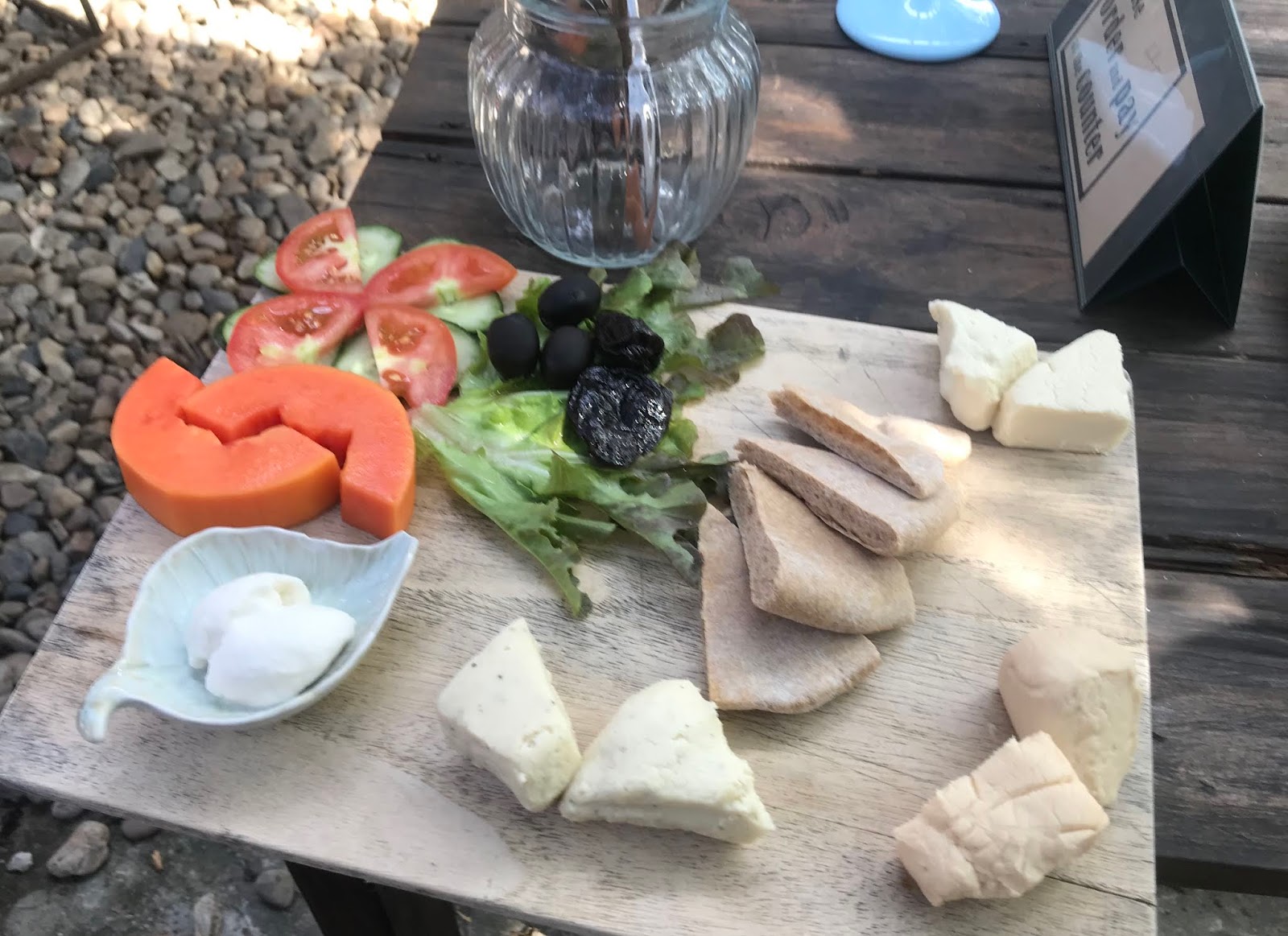
Or pretty much everything else I tried! This was a "cheese" platter.
You can't visit Thailand and not try the mango and sticky rice.
Needless to say, I didn’t deprive myself. Did I eat any Thai food? Of course - but not much, haha! I enjoy Asian food, but when it’s something that I eat almost every day in some form, I jump at the chance to have things that I could normally only get back home in the States. It was definitely a treat.

Modesty is required for tourists wishing to visit the temple.
Apart from eating my way across town - I practically tried a new restaurant each meal! - I was able to do some hiking and visit local landmarks. One hike took me partway up the mountain that overlooks the city. At a prominent point on the mountainside I arrived at a large Buddhist temple with an impressive view of the surrounding countryside. It was fascinating to walk around the place, smelling the incense, hearing the echoing gongs, and seeing all the glitter and relics that you'd normally just experience in a National Geographic. It was also intriguing to see the mix of ancient and modern, as monks in their orange robes happily snapped pictures of each other using their smartphones.

Beside the Monk's Trail leading up Doi Suthep
On the way back down, I passed a small structure that had a lovely view and was designated as a meditation spot. I noticed a plaque next to it and stopped to read what it said. Written on it were instructions for the curious seeker on how to pray. It was interesting to see a different religion’s concept of prayer, which involved a series of steps to gain merit, become one with nature, and reach a higher spiritual level. But it seemed empty of the meaning that I’ve found in Christianity’s teaching on prayer. To me, prayer is a way to talk to God, to share my deepest feelings, struggles, and hopes with One who knows me better than anyone else. As one author beautifully described it, “Prayer is the opening of the heart to God as to a friend.” Ellen White, Steps to Christ, p. 93.

Looking at those instructions, I was suddenly reminded of another set of instructions that I’ve read many times before. They are the words of Jesus: “In this manner, therefore, pray: Our Father in heaven…” It makes all the difference to me to know that I'm talking to Someone, that He's really listening, and that the One I’m praying to actually wants me to call Him my Father.

After seeing the views from the temple at Doi Suthep, another highlight was getting to visit the so-called Sticky Falls. I didn’t quite know what to expect at a place with a name like that, but I was rather surprised when I got there to see tourists blithely clambering up and down a set of waterfalls. Any other waterfall and you’d be getting the waterslide experience. Sticky Falls, on the other hand, was exactly that because the rocks had no slippery algae on them and had the same kind of traction you’d feel on the top of a skateboard. Some type of mineral in the water keeps the rocks clear of growth and it’s pretty cool! So I joined in and waded my way uphill feeling rather amused at how easy it was.
Don't try this at home. Unless Sticky Falls happens to be your home.
My sister says it looks fake and photo-shopped. Thanks.
Those were some of the main highlights of my week and a half in Chiang Mai. I also managed a quick blitz to the iconic Petronas Towers in KL during my stopover in the way back. It was a lovely trip overall, and some good time for a personal retreat. And by the looks of it, the timing of my little get-away worked out very nicely. As I write this post, Gary is making the final adjustments with the engine rigging on the plane, customers have been lined up, local ATC has been notified that Adventist Aviation is resuming operations. Somehow it’s hard to believe, but it looks like we really might be getting airborne. Soon.

Saturday, December 15, 2018

Rephidim


Runway at AAI where I exercise in the mornings and evenings.
I guess this kind of a post was bound to come sooner or later. I “knew” what I was getting into by signing on to be a missionary. You know—all those challenges that you hear people face in developing countries: getting sick, creepy crawlies, lack of resources, being far from home, unfamiliar language, strange food, etc. But hey, I’m already a TCK and an MK (lived in an urban mission field until age 7), I’ve gone on multiple school mission trips, I’ve roughed it on backpacking trips, and I feel like I’m a very adaptable guy.

Sure there would be bouts of missing friends and family, and frustration with having to learn how to live in a new culture. Yes, there would be the challenges of learning to communicate in a new language. Of course it would be hard. But it wasn’t supposed to be overwhelming. I mean, I was coming to work as a pilot.

And yet 3 months in, I’ve experienced a struggle I was not anticipating. First the unwelcome news about the damaged wing. Ok, we'll work on the backup plan and start flying. Then after delays in getting the necessary parts and deciding to go ahead with repainting the wing, the unexpected news that Gary was going to have to take a business trip to Europe, with no clear ETA on returning. He ended up being gone nearly a month, during which I lost a special friendship and was left scraping paint off the wing for days wondering what had happened and when things would get better. Then Simon the mechanic got sick and went home to Java, all but halting the remaining work on the plane.

When everyone eventually returned and the plane was finally ready for its government airworthiness inspection, Gary found out he’d be having to take another unscheduled trip out of the country for paperwork reasons. For how long? It wasn’t supposed to take more than 2 weeks. That was 2 weeks ago; the latest is that it could be another 2 weeks.

My current kingdom. At least I'm getting spoiled by the AC!
I was dreading him leaving again, remembering what those 3 ½ weeks in October and November were like. Those were rough, long days. I guess it was time for round two. This time I’ve found myself working alone in the parts room with the task of organizing a collection of components from 3 different types of aircraft, labeled and unlabeled, which has fallen into disarray over the past several years. At least Simon is still out working in the hangar and I take breaks to go and chat with him. But then it’s back to the parts room to try to make sense of the mess.

Waiting is hard. But waiting in uncertainty is harder. And being stuck with my thoughts and memories for hours on end while I wait is the hardest. It’s not even so much about the flying  anymore. I just need to able to immerse myself in something meaningful and rewarding, that has purpose. But what I came here to do remains beyond reach.
 
Yes, the reality of missionary life—in my own individually tailored version—is definitely setting in. The ironic thing is that if you look at it from a purely academic standpoint, I'm simply in the second stage of culture shock. Yes, as much as I hate to admit it, it’s true that the classic progression applies to me. But when you throw in the additional layers of uncertainty, loss, and the realization that I’m still discovering what makes me thrive and ultimately what my place in life is—I think it makes for a much more complex emotional brew.

So why am I writing all this? Partly to vent. To share that modern missionaries experience real emotional struggles. Guys too. But also to share a critical lesson that I’m in the middle of learning and relearning.

You see I recently read something in a devotional that made me stop and think. It was about the story of the Israelites on their way from Egypt to the Promised Land. They had just experienced a miraculous exit from Egypt, walked through the Red Sea on dry ground, and were now having the daily miracle of manna being provided for them to eat. With all these events in the recent weeks, we read that they “set out on their journey…and camped in Rephidim; but there was no water for the people to drink.” Exodus 17:1.

This was not good. Why in the world would this group of two million people end up in a place devoid of water? Because God led them there. That’s right. They weren't wandering along at random, neither was Moses choosing the route. God Himself was leading them visibly: “And the Lord went before them by day in a pillar of cloud to lead the way, and by night in a pillar of fire to give them light, so as to go by day and night. He did not take away the pillar of cloud by day or the pillar of fire by night from before the people.” Exodus 13:21. Supernatural, divine guidance doesn’t get any more obvious than that.

And yet, following all the miracles these people had just experienced, we find them becoming so desperate with their current circumstances that they were on the verge of stoning Moses. Right in the shadow of that visible token of God’s presence. Sure, their immediate need was real. But so was the manna they had just eaten that day. Did God really intend to kill His people by thirst, after having provided in every other way? What would be the point of a story like that?

So it’s easy for me to look at the story and point out the obvious. Hey guys, look! This isn’t some bad mistake. I mean, see the cloud over there! Of course God knows there’s no water here, so just ask for help and He'll take care of it. It’s so simple, right? And for those of you who are familiar with the story, you'll remember that God indeed worked another miracle and produced a water supply from the dry rock.

And then I realize it’s my own story. I didn’t end up here by some fluke of circumstances or the flip of a coin. No, this journey has been the result of many prayers and I can say God led me here. And here I am…struggling being in the place He has put me.

The words of the author Ellen White really start to hit home now:

“…every one who takes up his cross to follow Christ comes to a Rephidim in his experience…. Disappointment overtakes us; privations come; circumstances occur which bring us into difficult places. As we follow in the narrow way, doing our best, as we think, we find that grievous trials come to us. We think that we must have walked by our own wisdom far away from God. Conscience-stricken, we reason, if we had walked with God, we would never have suffered so…. But of old the Lord led His people to Rephidim, and He may choose to bring us there also, in order to test our faithfulness and loyalty to Him. In mercy to us, He does not always place us in the easiest places; for if He did, in our self-sufficiency we would forget that the Lord is our helper in time of necessity. But He longs to manifest Himself to us in our emergencies, and reveal the abundant supplies that are at our disposal, independent of our surroundings; and disappointment and trial are permitted to come upon us that we may realize our own helplessness, and learn to call upon the Lord for aid, as a child, when hungry and thirsty, calls upon its earthy father.” [Emphasis supplied] Signs of the Times, September 10, 1896.


Wow. This is where I’ve found myself. And this is where God is too. It’s okay to admit to the difficulty and the struggles. But I also have to admit that God knew exactly where this road would lead and He still took me on it. So that means He has a plan and my job is to simply ask Him to help me. Of course my needs aren’t immediate life and death problems such as running out of water, so the answer to the prayer will take longer. But it will come.

And it has already in some ways. I have a wonderful family spread across the world in multiple time zones, and almost anytime I need to call, one of them is awake and able to listen to me. A couple years ago the internet here in Papua was very poor; now I’m able to video call with very decent quality. Just to be able to talk to people who understand you like no one else is such a blessing—and from the other side of the world!

The entire Boyd tribe. (photo stolen from Facebook)
And I have family here too! The Boyd family, American missionaries with Adventist Aviation, have adopted me and in doing so helped me keep my sanity. They’ve made sure I always have a place to go on Friday evenings, they’ve listened to me, fed me, taken me hiking, and I don’t know what I would have done without them. I’m so grateful for them, and that’s another real manifestation that God is taking care of me.

As I finish up this post, I am feeling a lot better than last week. Of course things come in waves and I’ve got the classic human problem of forgetting lessons learned. But as a servant and child of God, I have the privilege of getting to see Him work miracles. So it’s only a matter of time until the next one.

On an abbreviated hike; we got back right before the downpour.

With the guys who still live at home and haven't left for college.
When I decided this was what I was going to write about, I was thinking, Boy, wouldn’t it be neat if God put a pillar of cloud outside that I could take a picture of so I can put it in my post? The very next day as I was walking back to the hangar from lunch, I came around the corner and there above the hills to the southwest I saw it. A beautiful towering column of cloud with an ethereal looking wispy halo on top illuminated by the sunshine above. It was spectacular.

I got a big grin on my face and my eyes misted up at the same time as I realized what I was looking at. My own pillar of cloud. Thank you Lord.

So right now, I’m right where God wants me to be. And even if it’s Rephidim, it’s good to know that Rephidim doesn't last forever. And while it continues, He's there right beside me.

Friday, November 16, 2018

A Day in the Life of a Pilot in Waiting

Spectacular atmospherics. And the noisy road below...

So…?! What’s the life of a missionary bush pilot like? Haha, I’m still wondering myself! The mammoth task of getting the first of our two planes back in the air still continues, and so far I’ve spent 2 1/2 months in Indonesia doing everything but flying. It’s been a blessing in disguise, however, as I’ve been afforded time to get everyday life figured out here, process through transition (pilots, the E in the IMSAFE acronym is a very real factor in flying), and be able to work on learning Bahasa.

Although I can’t say anything about the flying yet, I can talk about the more down-to-earth aspects of life here. Such as playing house! Figuring out how to set up my place was actually something I was dreading in coming here - like not knowing exactly what I would need to bring from the U.S., what things I could get here and where to find them. And then anticipating the process of getting settled in. But I managed, and just the other day I was realizing that I’d actually had a bit of fun in the process! The benefit of starting from scratch - I moved into an almost empty place - is that I could decide from the get-go what I really thought was essential to have in my house and then just get that. The end result has turned into a nice tidy place that is easy to keep from getting cluttered and has most of the functionality that I need in the way that I like it. I may decorate it a bit as time goes if I get the urge, but for now, I’m happy with my family photo fridge magnets and the wall map that I always gravitate toward.
More than just the fridge contents make me smile!

Of course I do more than just putter around the house. I actually stay fairly busy helping out at the Adventist Aviation hangar with whatever projects need doing. I’ve gotten to know some particular aircraft components very well as I’ve helped in the process of overhauling them. Right now my work days typically run from 8:00 - 6:00, with an hour for lunch in between. Once we start flying, though, it’s going to get pretty busy. I’m told we take off at sunrise at 5:30 and do flights all the way until we come back to home base around 5:00 in the evening. That’ll mean getting to bed rather early in order to be ready to take off at dawn. I guess I got some good preparation for that by working the early shift at EVA FTA!

I’m probably not going to have as much trouble falling asleep so early as staying asleep though. To help you understand what I’m talking about requires a little explanation about the noise levels here. As you might have gathered from the previous entry, I’m not in an isolated jungle outpost, but rather on the outskirts of a sizeable town. The road leading out of town happens to run right by our runway and if you close your eyes and just listen, you’d think there was a major freeway running next to the airbase property. It’s just a small road, but traffic is constantly flowing by from the early hours of the morning till late at night. Then, in the wee hours of the morning when the traffic is finally just a trickle, you’ll hear the 4:00 a.m. call to prayer from several masjids echoing over the countryside from loudspeakers.

But just when you’ve gotten acclimated to the baseline noise levels, you discover that sources of noise are not limited to the frequent obnoxious revving of motorbikes with modified mufflers; there are a number of folks in the local population (not on campus) who have considerably powerful sound systems and seem to think the entire neighborhood wants to hear their particular playlist. Do they choose the daytime to broadcast the musical selections? I don’t think I’ve heard music in the day once yet—they usually fire things up no earlier than 9:00 p.m. and continue far into the night. Sometimes they’re considerate and wait until you’ve already fallen asleep before powering on the speakers. One time they got going at the prime hour of 2:30 a.m. Back home, it might just be a matter of shutting the windows (and calling the police, haha!). But here… well, we don’t have glass panes to speak of, but, rather, large screen windows and some flimsy glass slats that can be closed if there’s a driving rain getting things wet. So sound-proofing is non-existant.

Just a couple days ago I’d gotten to bed nice and early and was blissfully dead to the world until a driving beat woke me up just before midnight. Great. I put in my earplugs, but that just focused the sound. After turning both fans in my room to the highest speed for the maximum amount of white noise, I felt like I was in a veritable hurricane, yet I still could hear the dum, dum, dum, dum, dah, dah, boom, tish! Oh brother.

Sometimes when I show up to work at the hangar in the mornings, Simon will ask, “Lombart, did you sleep good last night?” to which I’ll chuckle, knowing he was treated to the same concert that I had. Right now it’s kind of hit and miss as to when the music plays at night. Lately it’s been fairly “quiet” but I’m told that as we approach the Christmas season, every street corner is going to have a boombox playing Christmas songs 24/7 at max volume. And when it comes to sleeping through noise, apparently it’s not even worth trying on New Year’s Eve; the fireworks will be going off constantly from sunset to midnight.

Housekeeping and noisy neighborhoods aside, where does this leave me in the timeline for getting airborne? I’m not going to make any hard and fast predictions, since most things take about 3x as long to accomplish here as expected. But… as of this writing, we’ve reached a major milestone with PK-TCA, and it now has two wings again like a proper airplane should! Tasks that still need accomplishing between now and flight day include, but are not limited to: rigging flight controls, weighing the aircraft (yep on some actual scales!), rigging the engine and then test running it, and getting the airworthiness certificate signed off by the DGCA. Looking at the long road the program has traveled, we’re almost there. So for your sake, you can hope that we’re up and flying soon so I can start writing about things more interesting than my gripes about the noisy neighbors! (Again, not referring to my colleagues on campus.) On that note, let me leave you with a few words of encouragement: "And let us not grow weary while doing good, for in due season we shall reap if we do not lose heart." Galatians 5:6 NKJV.
Only a matter of time now...